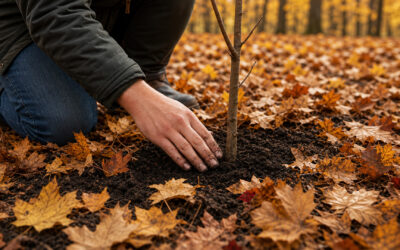

The best time to fertilize trees in Missouri is late fall, after the first hard freeze and before the ground freezes. Early spring is the second choice. Mid-summer is the time to leave the bag in the shed.
Before you grab one, check what your tree needs. Fertilizer helps when it matches the soil and the season, and a guess usually misses on both.
Here is how to tell when to fertilize yourself and when it makes sense to call someone who does this every day.
Do Your Trees Need Fertilizer?
Many yard trees do. In the woods, fallen leaves break down and put nutrients back in the soil. A tree in your yard has a harder time. The leaves get raked away, the lawn uses up nutrients in the soil, and yard soil is often packed down or thin. Over time, the tree runs short on what it needs.
These signs point to a tree that needs a boost:
- Slow growth from one year to the next
- Thin, pale, or yellow leaves
- Leaves that drop early in the season
The best way to know what is missing is a soil test. A soil test is a lab check of a soil sample that shows which nutrients are low, so the fertilizer matches the need.
Yellow or thin leaves can also come from disease, pests, or water stress, so it pays to find the cause before you treat. Our post on why leaves on a tree turn yellow covers the common ones.
Why Timing Matters
Fertilizer only helps when roots can use it. Tree roots spread through the root zone, which is the soil under and around the tree, often reaching past the edge of the branches.
In fall, a tree goes dormant, which means its growth slows down for winter. The leaves drop and the top stops growing, but the roots can keep taking in nutrients while the soil stays workable. Those nutrients are in the soil when growth starts in spring.
Fertilize too late in summer and you push new growth that the first cold snap damages. Mid-July is the cutoff.
When to Fertilize Trees in the Fall
In mid-Missouri, late October through early December is the best window. It opens after the first hard freeze, when a freeze ends the growing season for the year, and it closes when the soil freezes solid.
If it is early October and the leaves are still green, you can wait. You are not out of time until the ground freezes. Weather changes from year to year, and Jefferson City does not always match the Lake of the Ozarks. Watch the weather more than the calendar.
Our fall tree checklist covers other jobs that fit this time of year.
When to Fertilize Trees in the Spring
Missed the fall window? March or April is the second choice. Early spring fertilizer is in the soil when growth starts.
Hold off after mid-July, and wait for spring if the ground is frozen.
How to Choose a Fertilizer
The bag shows three numbers, like 10-10-10. Those numbers are the N-P-K ratio, which stands for nitrogen (N), phosphorus (P), and potassium (K). Nitrogen drives leaf and branch growth. Phosphorus supports roots. Potassium supports overall health.
Nitrogen is usually what trees run short on. We look for a fertilizer with more nitrogen than phosphorus and potassium, in a ratio such as 3-1-1 or 2-1-1. A balanced 10-10-10 is often not the best match for a shade tree, because it may add phosphorus and potassium your soil already has. A soil test tells you for sure.
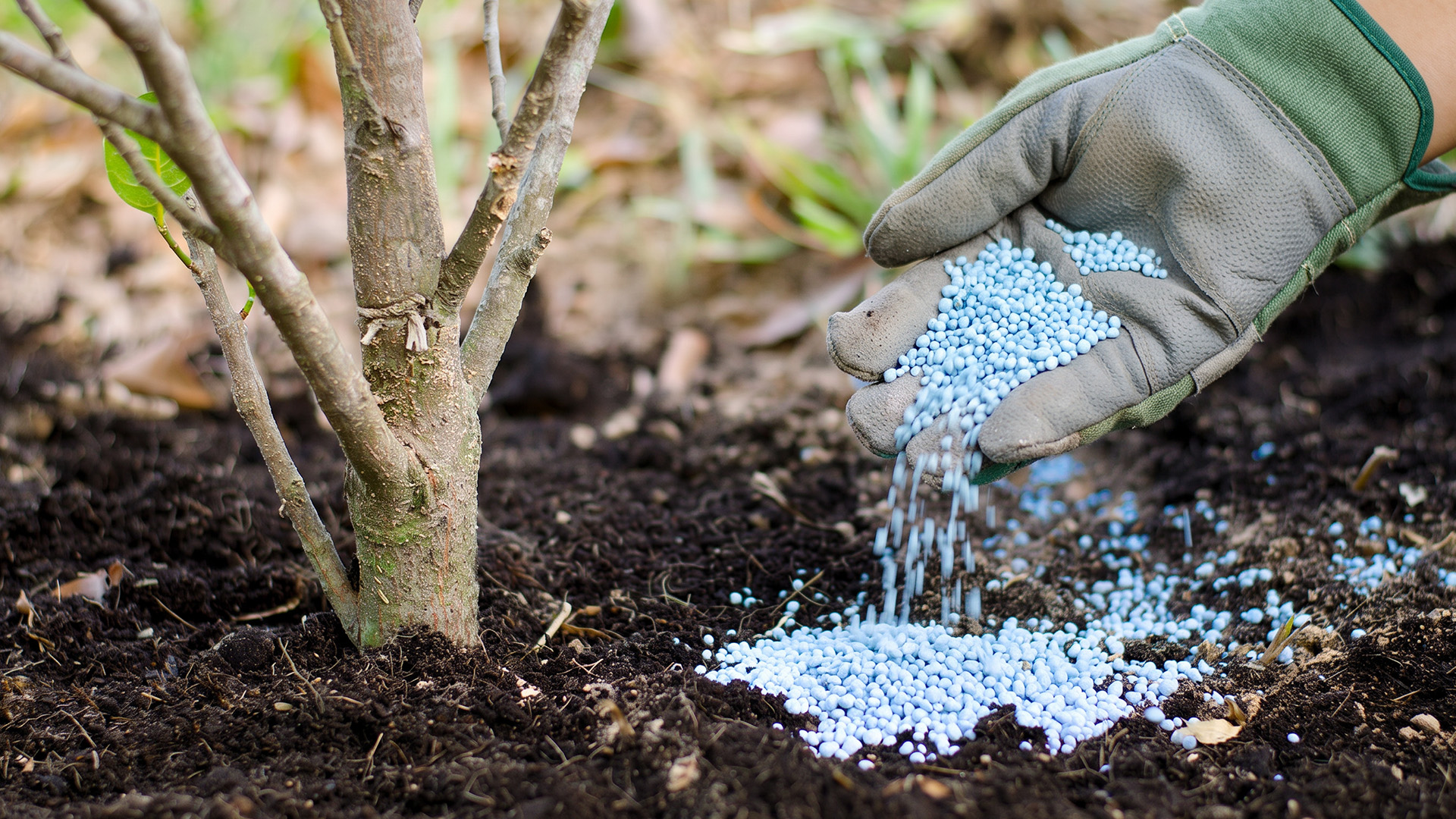
Slow-release fertilizer is a common pick. It feeds over several months instead of all at once, which lowers the risk of too much growth at one time.
How Fertilizer Gets Applied
There are three common ways to get fertilizer to the roots:
- Spread on the surface: granules go over the whole root zone, not just near the trunk.
- Drilled holes: fertilizer goes into holes in the soil for deeper placement.
- Soil injection: a crew pushes liquid fertilizer into the soil with a pressurized needle.
What Is Deep Root Fertilization?
Deep root fertilization is fertilizer placed into the soil near the roots, usually as a liquid under pressure. It puts nutrients closer to the roots instead of leaving them on the surface. The same windows apply: fall or early spring.
Should You Do It Yourself or Call a Pro?
You can fertilize a small tree yourself, but it is easy to get wrong. The wrong product, amount, or timing can set a tree back, and the damage is hard to undo. Large or mature trees raise the stakes. They have a wide root zone, and covering it evenly takes more fertilizer, more equipment, and more experience.
A professional removes the guesswork. Our certified arborists start every tree fertilization job by looking at your trees and your soil, then build a plan around what they find. That keeps the plan matched to your trees and your yard.
Tree Fertilization FAQ
Can you give a tree too much fertilizer?
Yes. Too much can burn roots, cause weak growth, and wash into nearby water. A professional who tests the soil and picks the product lowers that risk.
How often should you fertilize trees?
There is no single schedule for every yard. A soil test and how the tree is growing tell you more than the calendar does, and an arborist can set a plan for your trees.
Should you fertilize a newly planted tree?
Usually a new tree needs water, mulch, and time before it needs fertilizer. See our guide to planting trees in the fall for what a new tree needs first.
Not Sure What Your Trees Need?
If you are not sure whether your trees need fertilizer, or when the right time is for your yard, contact Hentges Tree Service at 573-893-2896. We can look at your trees and tell you what they need. Jefferson City is home base, but we serve throughout mid-Missouri, including Tipton, Stover, Versailles, Lake of the Ozarks, Eugene, St. Elizabeth, Westphalia, Linn, Fulton, Kingdom City, Columbia, Boonville, and the communities in between.
DO YOU NEED HELP?
We’re here to serve you and we provide free estimates.